
In an era where chronic non‑communicable diseases place an ever‑growing burden on healthcare systems worldwide, a quiet but determined revolution is taking shape. At the intersection of traditional botanical wisdom and modern biomedical science stands the Multi‑Target Sustainable Solution (MTSS) — a research initiative and therapeutic framework born from years of dedicated observation, rigorous experimentation, and a deep commitment to patient well‑being. Its mission is both ambitious and urgent: to transform the treatment of cerebrovascular and neurological disorders through a holistic, sustainable, and evidence‑based approach that can be scaled across diverse populations and healthcare settings.
The Genesis of MTSS
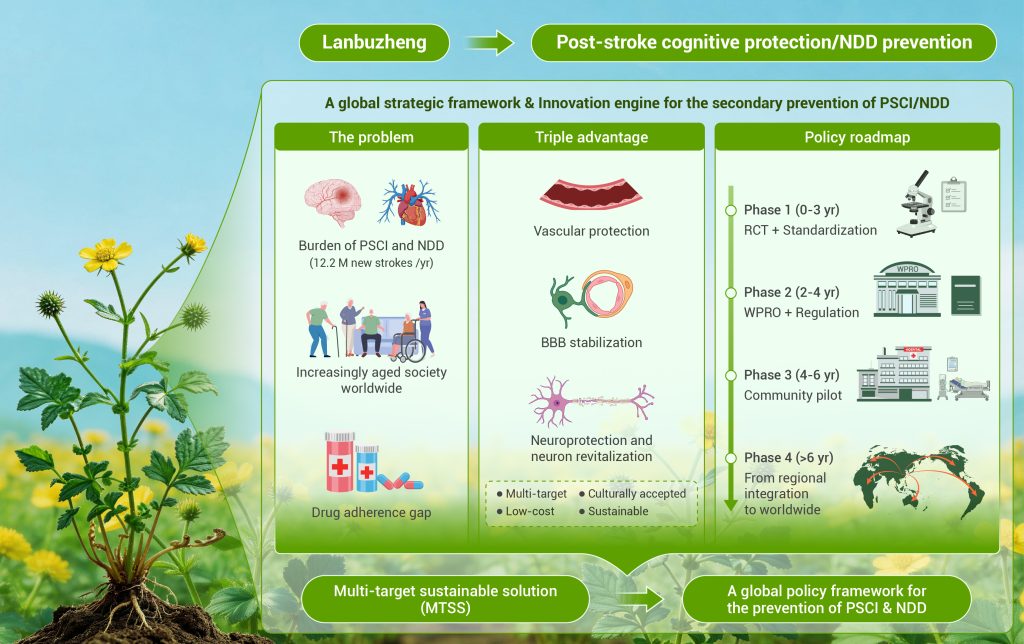
The MTSS framework emerged from the pioneering work of researchers who recognized that many complex diseases — including stroke, Alzheimer’s disease, Parkinson’s disease, and other neurodegenerative conditions — cannot be adequately addressed by single‑target pharmaceuticals alone. The underlying pathophysiology involves intertwined pathways: inflammation, oxidative stress, excitotoxicity, mitochondrial dysfunction, blood‑brain barrier disruption, and vascular insufficiency. A multi‑target strategy, grounded in nature’s own combinatorial chemistry, offers a more rational and potentially safer path forward.
Central to this vision is the medicinal plant Geum japonicum (commonly known as blue buttercup or lanbuzheng), whose extracts have shown remarkable promise in stabilizing neural function after vascular injury and in supporting recovery from neurodegenerative decline. Through systematic investigation and real‑world clinical observation, the MTSS team has documented cases where patients with stroke, cardiovascular disease, dementia, and even certain cancers have experienced unexpected and meaningful improvements. These anecdotal successes, now supported by published academic research, form the empirical bedrock of the MTSS mission.
The Three Pillars of the MTSS Mission
1. Multi‑Target Mechanism
Unlike conventional drugs designed to hit a single molecular target, MTSS embraces the complexity of human biology. By harnessing the synergistic effects of multiple bioactive compounds found in standardized plant extracts, the framework aims to simultaneously modulate inflammation, enhance cerebral blood flow, protect neuronal integrity, and support neuroplasticity. This approach not only addresses the root causes of disease but also reduces the risk of drug resistance and side effects commonly associated with high‑dose monotherapies.
2. Sustainability — from Source to System
Sustainability is woven into every layer of the MTSS vision. Environmentally, it promotes Good Agricultural and Collection Practices (GACP) for wild and cultivated medicinal plants, ensuring biodiversity conservation and supply chain resilience. Economically, it seeks to create value for local farming communities while keeping therapies affordable for patients in low‑ and middle‑income countries. Scientifically, sustainability means generating reproducible, long‑term evidence through well‑designed clinical trials and real‑world data collection — not just short‑term gains.
3. Global Collaboration and Equity
MTSS is not the work of a single laboratory or country. It is a growing coalition of scientists, clinicians, policy advisors, and patient advocates from China, Australia, South Africa, and beyond. The encouragement received from the Australian Department of Health, Disability and Ageing underscores the relevance of this work to aging populations worldwide. The mission explicitly aims to bridge the gap between cutting‑edge research and underserved communities, making effective treatments accessible regardless of geography or economic status.
Scientific Foundation and Early Evidence
The MTSS framework rests on a solid foundation of published academic work. The team’s flagship paper, published in The Innovation(2026), outlines the theoretical model and presents preliminary data on the integration of Geum japonicuminto a multi‑target protocol for cerebrovascular protection. Complementing this are decades of ethnobotanical knowledge and a growing body of pharmacological studies that reveal the plant’s ability to modulate key signaling pathways involved in neurodegeneration.
Two key observations by lead researcher Shen Jianghong capture the essence of what MTSS can achieve:
Observation One: Geum japonicumextract demonstrates an immediate and pronounced effect on central nervous system dysfunction following cardiovascular and cerebrovascular injury.
Observation Two: The extract likely possesses a unique mechanism that provides supportive modulation for neurodegenerative diseases, offering hope for conditions that currently lack effective disease‑modifying therapies.
These insights, combined with encouraging feedback from patients and clinicians, fuel the determination to push forward into rigorous clinical validation.
The Road Ahead: Join the MTSS Task Force
The ultimate goal of MTSS is to move from promising observations to validated, scalable interventions that can change clinical practice. To achieve this, the initiative is actively building an international MTSS Task Force — a collaborative network of researchers, healthcare providers, regulatory experts, and community leaders committed to advancing multi‑target sustainable medicine.
Current priorities include:
Conducting Phase I/II clinical trials for Geum japonicumextracts in post‑stroke cognitive impairment.
Establishing standardized fingerprinting and quality control protocols for raw materials.
Developing digital platforms for real‑world evidence collection and patient monitoring.
Engaging with regulatory agencies in China, Australia, and Africa to define clear pathways for botanical drug registration.
As the MTSS mission gains momentum, the call goes out to talented individuals worldwide: Join the MTSS Task Force — unite global minds to pioneer multi‑target, sustainable solutions for brain and vascular health. Whether you are a pharmacologist, a neurologist, a botanist, a data scientist, or a policy advocate, there is a place for your expertise in this collective endeavor.
Conclusion
The MTSS mission is driven by a simple yet powerful conviction: that nature, guided by science and delivered with compassion, can offer answers where conventional approaches fall short. With the support of governments, academic institutions, and a growing community of believers, MTSS is poised to make a lasting impact on millions of lives. The journey from discovery to widespread benefit is long, but every step brings us closer to a future where brain and vascular health are no longer a privilege but a universal right.
Together, we can turn the promise of multi‑target sustainable solutions into reality.

Leave a Reply